BLOG
How to Start Dropshipping on Shopify (Step-by-Step Guide)
By Darren DeFeo | Updated on August 26, 2026
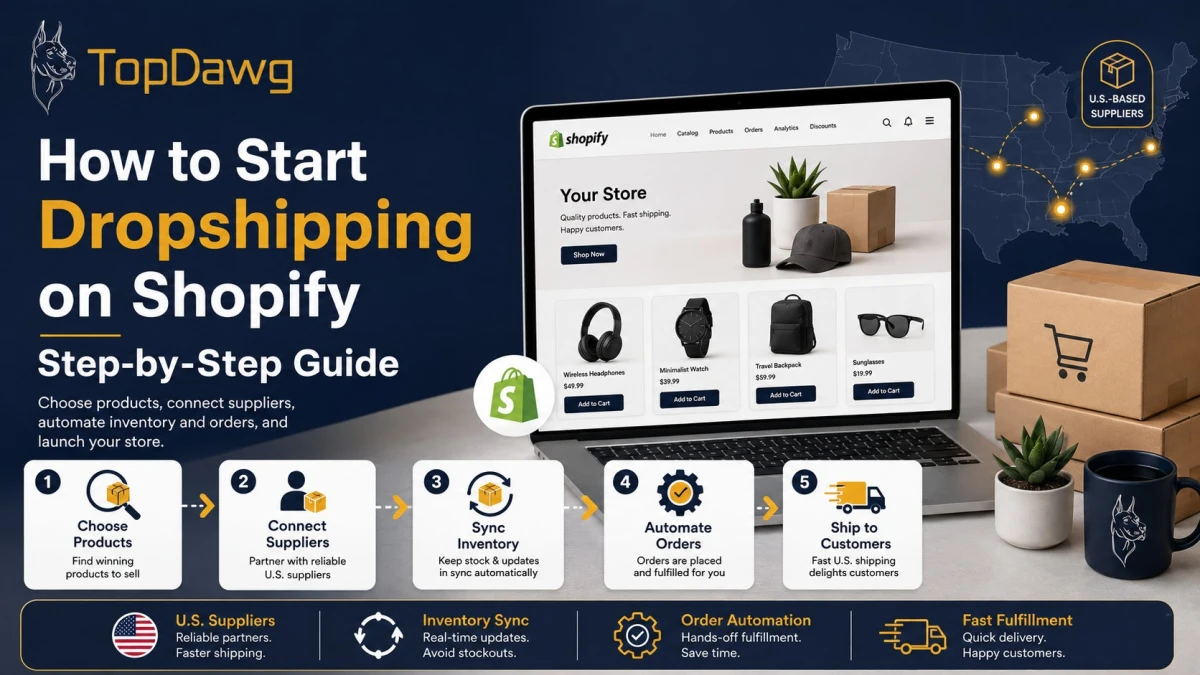
A Complete Guide to Choosing U.S. Suppliers, Adding Products, Automating Inventory and Orders, and Building a Shopify Dropshipping Store That Can Scale
Starting a dropshipping business on Shopify can be one of the most accessible ways to launch an ecommerce store without purchasing large quantities of inventory upfront.
Instead of stocking products in your own warehouse, you connect your Shopify store with dropshipping suppliers that maintain the inventory and fulfill customer orders on your behalf. Your job is to build the store, choose products, set pricing, attract customers, manage the customer relationship, and operate the business.
But there is an important distinction between starting a Shopify dropshipping store and building one that can actually grow.
A store may be easy to launch. A scalable business requires more.
You need reliable suppliers, accurate product information, synchronized inventory, sensible pricing, automated order processing, dependable fulfillment, shipment tracking, customer service, and a clear marketing strategy.
For retailers selling primarily to U.S. consumers, working with domestic suppliers can also help reduce long international delivery windows and create a more predictable fulfillment experience.
This step-by-step guide explains how to start dropshipping on Shopify from the ground up, including how to choose products, evaluate suppliers, build your storefront, automate essential operations, understand your responsibilities as the retailer, and prepare your store for growth.
If you already have a Shopify store and are ready to connect it directly with U.S.-based suppliers, explore the TopDawg Shopify dropshipping app and integration.
🚀 How to Start Dropshipping on Shopify: The Quick Answer
To start a dropshipping business on Shopify, create a Shopify store, choose a product niche, find reliable dropshipping suppliers, connect a supplier or dropshipping app, import products, set your pricing, configure payments and shipping, test your checkout and fulfillment process, and then begin marketing your store.
A basic Shopify dropshipping workflow looks like this:
Supplier → Shopify Store → Customer Order → Automated Order Processing → Supplier Fulfillment → Tracking → Customer Delivery
The major advantage of dropshipping is that the retailer does not need to purchase and warehouse every product before making a sale.
However, the retailer still operates the ecommerce business.
That means you remain responsible for important areas such as:
✅ Product selection
✅ Product descriptions and merchandising
✅ Retail pricing
✅ Customer acquisition
✅ Checkout experience
✅ Customer communication
✅ Returns and refunds
✅ Supplier selection
✅ Marketplace and legal compliance
✅ Overall customer satisfaction
The supplier fulfills the product, but your Shopify store owns the customer relationship.
That distinction is one of the most important things new dropshippers need to understand.
🛒 What Is Shopify Dropshipping?
Shopify dropshipping is an ecommerce fulfillment model where products are sold through a Shopify store but physically stored and shipped by third-party suppliers.
When a customer places an order:
- The customer purchases the product through your Shopify storefront.
- The order enters your Shopify administration and connected fulfillment workflow.
- The appropriate supplier receives the order information.
- The supplier prepares and ships the product directly to the customer.
- Shipment and tracking information is returned to the retailer through the connected workflow where supported.
- The retailer continues managing the customer experience.
You never need to physically handle each product yourself.
This is different from traditional retail, where the merchant may purchase hundreds or thousands of dollars of inventory, receive the merchandise, store it, package individual orders, and arrange shipping.
If you want a more detailed explanation of the overall business model before building your store, read What Is Dropshipping?.
📦 Why Shopify Works Well for Dropshipping
Shopify provides the ecommerce storefront and commerce infrastructure, while dropshipping suppliers provide the product inventory and fulfillment.
Together, they allow retailers to separate two major functions:
Shopify handles the storefront and commerce experience.
The supplier handles physical inventory and fulfillment.
A dropshipping platform or integration connects the two.
That connection can automate many of the operational steps that would otherwise need to be completed manually.
🧭 Step 1: Decide What Type of Shopify Dropshipping Store You Want to Build
One of the biggest mistakes new retailers make is opening a Shopify account before deciding what kind of business they actually want to create.
The technology should support the business strategy—not replace it.
Before choosing products, answer a few basic questions.
🎯 Who Is Your Target Customer?
Instead of saying, "I want to sell products online," define the customer you want to serve.
For example:
✅ Pet owners
✅ Outdoor enthusiasts
✅ Homeowners
✅ Parents
✅ Fashion shoppers
✅ Fitness consumers
✅ Hobbyists
✅ Gift buyers
✅ Automotive enthusiasts
The clearer the audience becomes, the easier it is to make decisions about products, branding, content, advertising, and merchandising.
🛍️ Will You Build a Niche Store or General Store?
A niche Shopify store focuses on a defined category or customer.
A general store offers products across multiple categories.
Both models can work, but niche stores often make branding and audience targeting easier because the products share a common customer profile.
For example, a pet-focused store can create collections around dogs, cats, travel accessories, grooming, toys, feeding, and pet-owner lifestyles.
A general store offers broader testing flexibility but usually requires more disciplined merchandising to avoid feeling random.
💡 Think Beyond a Single "Winning Product"
Products gain and lose popularity.
Instead of building the entire business around one item, consider whether successful products can lead naturally to related merchandise.
A strong store has room to grow.
🔎 Step 2: Research Products Before You Build the Store
Product selection is one of the most important decisions in dropshipping.
The goal should not simply be finding products that look interesting.
Look for products that make sense economically, operationally, and from a marketing perspective.
✅ What Makes a Good Dropshipping Product?
There is no perfect formula, but useful characteristics can include:
✅ Clear customer use case
✅ Understandable value proposition
✅ Attractive retail margin potential
✅ Reasonable shipping characteristics
✅ Strong images and product information
✅ Reliable supplier inventory
✅ Low likelihood of excessive returns
✅ Potential for complementary products
✅ Ability to demonstrate or market visually
✅ Clear target audience
Retailers looking for ideas can explore TopDawg's dropshipping product catalog to research merchandise across multiple consumer categories.
📊 Evaluate the Economics Before Importing Products
Never select a product based only on its retail selling price.
Estimate profitability using:
Retail Selling Price
– Wholesale Product Cost
– Shipping Cost
– Payment Processing Costs
– Advertising / Customer Acquisition Cost
– Returns and Refund Allowance
– Applicable Platform or App Costs
– Other Operating Expenses
= Estimated Profit
A $50 product is not necessarily more profitable than a $30 product.
Margin depends on the entire cost structure.
📦 Consider Fulfillment Before Marketing Potential
A product may look fantastic in an advertisement but become a poor choice if it is frequently out of stock, difficult to ship, highly fragile, or prone to returns.
Ask:
✅ Where is the product stored?
✅ How quickly does the supplier process orders?
✅ Which carriers are used?
✅ Is inventory data available electronically?
✅ Are tracking numbers provided?
✅ What happens when a customer requests a return?
✅ Is the supplier dependable during periods of increased demand?
Products and operations need to work together.
🇺🇸 Step 3: Choose Reliable Shopify Dropshipping Suppliers
Your suppliers become an invisible extension of your brand.
Customers may never know the supplier's name, but they will absolutely notice when the supplier performs poorly.
When an order is late, damaged, incorrect, or canceled, the customer contacts your store.
That makes supplier selection one of the most important decisions in Shopify dropshipping.
🚚 Why U.S.-Based Suppliers Can Be Valuable
For retailers selling primarily to U.S. customers, domestic suppliers can create several operational advantages.
These may include:
✅ Shorter shipping distances
✅ More predictable domestic transit
✅ Fewer international transportation variables
✅ No customer-facing customs delays for inventory already warehoused domestically
✅ Familiar U.S. carrier networks
✅ More straightforward domestic tracking
✅ Potentially easier return logistics
TopDawg explains these advantages in greater detail in its guide to U.S. dropshipping suppliers.
🔍 What Should You Look for in a Shopify Dropshipping Supplier?
Evaluate more than the wholesale price.
Look for:
✅ Reliable inventory
✅ Accurate product data
✅ Consistent fulfillment
✅ Clear shipping procedures
✅ Tracking availability
✅ Responsive support
✅ Competitive wholesale pricing
✅ Product quality
✅ Returns procedures
✅ Technology integration
✅ Ability to scale
A slightly higher wholesale cost can sometimes be worthwhile if it helps reduce cancellations, customer complaints, shipping problems, and administrative work.
Your Shopify store is only as strong as the suppliers behind it.
Build your catalog around dependable products and fulfillment—not just the lowest wholesale price.
🏗️ Step 4: Create Your Shopify Store
Once you understand your market and supplier strategy, you can begin building your Shopify storefront.
Shopify's setup process allows merchants to establish a store, add products, select a theme, create collections, and configure a custom domain.
🏷️ Choose a Store and Brand Name
Your store name should ideally be:
✅ Easy to remember
✅ Easy to spell
✅ Relevant to your market
✅ Flexible enough to allow growth
✅ Available as a domain
✅ Distinguishable from existing brands
Before finalizing a name, research potential trademark conflicts and domain availability.
Avoid creating a brand that is too narrowly tied to one temporary product unless that is genuinely your long-term strategy.
🌐 Connect a Custom Domain
A custom domain creates a more professional customer experience than relying solely on a default store URL.
Ideally, your domain should closely match your store or brand name.
Keep it short, memorable, and easy for customers to type.
🎨 Select a Shopify Theme
Your theme controls much of your store's visual presentation.
New retailers frequently overcomplicate this step.
A good dropshipping storefront does not need excessive animations or design effects. It needs to help shoppers understand the products and move naturally toward checkout.
Focus on:
✅ Mobile responsiveness
✅ Fast loading
✅ Clear navigation
✅ Readable product pages
✅ Prominent product photography
✅ Strong calls to action
✅ Trust-building design
✅ Simple checkout flow
Your design should support purchasing decisions rather than distract from them.
🧩 Step 5: Connect a Dropshipping Platform or Shopify App
This is where the operational side of Shopify dropshipping begins.
Technically, retailers can manage supplier orders manually.
But manually copying order information between systems becomes increasingly inefficient as product counts and sales increase.
A connected dropshipping platform can link the Shopify store with supplier inventory and fulfillment.
⚙️ What Should a Shopify Dropshipping Integration Do?
Depending on the platform and feature set, an integration can help support:
✅ Product importing
✅ Product data synchronization
✅ Inventory updates
✅ Pricing management
✅ Order routing
✅ Supplier fulfillment workflows
✅ Shipment tracking
✅ Multi-product catalog management
This is the area where your informational blog should deliberately hand the visitor to the commercial solution page.
Ready to connect your store instead of managing suppliers manually?
Explore the TopDawg Shopify dropshipping app and see how U.S. supplier sourcing and ecommerce automation work together.
📥 Step 6: Import Products Into Shopify
Once your supplier system is connected, you can begin building your store catalog.
But resist the temptation to import hundreds or thousands of products immediately.
A thoughtful catalog usually performs better than a disorganized collection of unrelated merchandise.
📝 Review Every Product Before Publishing
Supplier product data gives you a starting point.
Your storefront still needs retailer oversight.
Before publishing, review:
✅ Product title
✅ Description
✅ Product images
✅ Product variants
✅ Pricing
✅ Inventory
✅ Shipping expectations
✅ Product specifications
✅ Category placement
✅ SEO title and description where appropriate
Do not assume that supplier-provided copy is automatically optimized for your audience.
✍️ Improve Product Descriptions
A product description should answer the customer's key questions.
Instead of simply listing technical details, explain:
What is it?
Who is it for?
What problem does it solve?
What are the important features?
Why would someone choose it?
What should the customer know before ordering?
Useful descriptions improve both conversion potential and search-engine understanding.
🗂️ Create Logical Collections
Shopify collections help organize products.
Instead of dumping everything into one catalog, organize merchandise based on how customers naturally shop.
You could build collections by:
✅ Product type
✅ Customer
✅ Use case
✅ Price range
✅ Season
✅ New arrivals
✅ Best sellers
✅ Gift category
Good ecommerce architecture helps both users and search engines understand the relationships among your products.
💵 Step 7: Build a Shopify Dropshipping Pricing Strategy
Pricing should never be an afterthought.
A successful dropshipping business needs enough margin to absorb the costs associated with customer acquisition, payment processing, customer support, returns, and normal operating expenses.
🧮 Start with Your True Product Cost
Wholesale price is only one component.
Calculate:
Product cost + shipping + processing + acquisition + expected returns + operating costs
Then determine whether the final retail price is realistic in your market.
📈 Avoid Competing Only on Price
Trying to be the cheapest store online is rarely a durable strategy.
Customers also value:
✅ Product selection
✅ Trust
✅ Store quality
✅ Customer service
✅ Clear information
✅ Fast shipping
✅ Convenience
✅ Brand experience
A professionally presented $39 product may outperform the same item listed carelessly for $34.
💰 Understand Your Break-Even Point
If you sell an item for $50 and all non-advertising costs equal $35, you have $15 remaining before marketing and profit.
If it costs $12 in advertising to acquire a customer, the transaction leaves approximately $3 before other expenses.
That is why successful retailers understand unit economics before aggressively scaling traffic.
Retailers evaluating platform costs can compare available options on the TopDawg membership pricing page.
⚙️ Step 8: Automate Shopify Inventory and Order Processing
Automation is one of the biggest differences between operating a small experimental store and building a scalable ecommerce business.
Manual processes can appear manageable until sales increase.
Imagine receiving 100 orders during a busy day and manually:
❌ Checking supplier inventory
❌ Copying customer addresses
❌ Entering product SKUs
❌ Sending orders to suppliers
❌ Retrieving tracking numbers
❌ Updating fulfillment information
Automation reduces repetitive work and gives the retailer more time for marketing, merchandising, customer support, and growth.
🔄 Inventory Synchronization
Inventory synchronization helps keep the quantities displayed in Shopify aligned with supplier availability.
This helps reduce situations where your store sells merchandise that the supplier no longer has available.
Accurate inventory becomes particularly important when:
✅ Advertising campaigns increase traffic
✅ Products become popular unexpectedly
✅ The same supplier inventory changes frequently
✅ A retailer operates a large product catalog
📦 Automated Order Routing
When a customer places an order, a connected system can move that transaction into the supplier fulfillment workflow.
The principle is simple:
A customer should not need the retailer to manually recreate the same order in another system before fulfillment can begin.
🚚 Tracking and Fulfillment Updates
Once the supplier ships the product, tracking information can flow through the connected workflow where supported.
This gives the retailer better visibility and reduces administrative work.
For a deeper explanation of the entire fulfillment chain, read How Dropshipping Orders Actually Work: From Checkout to Delivery.
💳 Step 9: Configure Payments, Shipping, Taxes, and Store Policies
A Shopify dropshipping store is still a real retail business.
Before launch, configure the commercial settings carefully.
💳 Payment Processing
Set up the payment methods you plan to accept and test the checkout process.
Customers should be able to understand:
✅ Product price
✅ Applicable shipping
✅ Applicable taxes
✅ Total cost
✅ Payment options
Avoid surprises at checkout whenever possible.
🚚 Shipping Information
Clearly communicate shipping and processing expectations.
Shopify specifically advises merchants using dropshipping to provide publicly accessible processing and shipping information, including relevant timeframes and additional fees, and notes that merchants remain responsible for compliance with applicable laws and policies.
Customers should know what to expect before purchasing.
↩️ Returns and Refunds
Create clearly accessible policies addressing:
✅ Returns
✅ Refunds
✅ Damaged merchandise
✅ Cancellations
✅ Shipping
✅ Privacy
✅ Terms and conditions
Do not simply copy another retailer's policies.
Your policies should reflect how your business actually operates.
🛡️ Step 10: Understand Your Compliance Responsibilities
Using a dropshipping supplier does not transfer all retail responsibility to the supplier.
You are still operating the store and selling products to customers.
Shopify states that dropshipping merchants remain responsible for complying with applicable laws and regulations related to the products they sell, including areas such as product safety, recalls, shipping disclosures, and refunds.
🧯 Product Safety
Understand whether products have applicable safety requirements, labeling requirements, certifications, warnings, or restrictions.
Do not assume every product a supplier offers can legally be sold to every customer in every jurisdiction.
©️ Intellectual Property
Avoid unauthorized trademark, copyright, or brand use.
Product sourcing does not automatically provide the right to market an item using another company's intellectual property.
🔐 Privacy and Customer Data
Your Shopify store processes customer information.
Maintain appropriate privacy practices and understand the requirements that apply to your business and customers.
📄 Accurate Advertising
Do not make product claims you cannot substantiate.
Product titles, descriptions, specifications, photographs, and marketing materials should accurately represent the merchandise customers will receive.
Key takeaway: Automation can make a Shopify dropshipping business more efficient, but automation does not replace merchant responsibility.
🧪 Step 11: Test Your Shopify Dropshipping Store Before Launching
Do not wait for your first real customer to discover whether your systems work.
Perform test transactions before sending meaningful traffic to the store.
🛒 Test the Customer Experience
Walk through your website like a first-time visitor.
Ask:
✅ Is navigation obvious?
✅ Are product images clear?
✅ Are descriptions complete?
✅ Is shipping information easy to find?
✅ Does the store work well on mobile?
✅ Does checkout function correctly?
✅ Do confirmation emails look professional?
✅ Can customers easily contact the business?
📦 Test the Fulfillment Workflow
Place a test order or otherwise verify the complete process whenever practical.
Confirm:
Shopify Order → Dropshipping Platform → Supplier → Fulfillment → Tracking
A successful checkout does not mean the backend is functioning correctly.
The entire chain matters.
🔍 Order Samples When Appropriate
Testing supplier products can help you evaluate:
✅ Product quality
✅ Packaging
✅ Processing speed
✅ Shipping time
✅ Tracking accuracy
✅ Overall customer experience
Remember: your customer judges the store based on the experience they receive, regardless of which company physically ships the package.
🚀 Step 12: Launch and Market Your Shopify Dropshipping Store
Once the operational foundation is working, start attracting customers.
A store without traffic is simply a website.
🔍 Search Engine Optimization
SEO can create long-term organic traffic by helping search engines understand your store and products.
Focus on:
✅ Useful product descriptions
✅ Descriptive category pages
✅ Informational blog content
✅ Logical internal linking
✅ Clear page titles
✅ Meta descriptions
✅ Image alt text
✅ Fast mobile performance
✅ Helpful customer-focused content
Your content should address actual questions customers ask.
📱 Social Media Marketing
Platforms such as TikTok, Instagram, Facebook, Pinterest, and YouTube can help retailers demonstrate products and build awareness.
Visual products often work particularly well with:
✅ Demonstrations
✅ Tutorials
✅ Comparisons
✅ Lifestyle content
✅ Before-and-after scenarios
✅ Product use cases
✅ Customer-generated content
💰 Paid Advertising
Paid search and social advertising can produce traffic quickly but should be approached carefully.
Know your conversion rate, average order value, gross margin, and customer acquisition cost.
Scaling unprofitable advertising only creates larger losses.
✉️ Email Marketing
Email helps retailers communicate with visitors and existing customers without paying for every future interaction.
Useful campaigns include:
✅ Welcome sequences
✅ Abandoned-cart emails
✅ Product announcements
✅ Promotional offers
✅ Seasonal campaigns
✅ Educational content
✅ Customer re-engagement
Building an audience you can reach repeatedly makes the business less dependent on any single traffic source.
📊 Step 13: Measure What Is Actually Working
Launching the store is the beginning—not the finish line.
Monitor performance continuously.
Important ecommerce metrics can include:
✅ Store traffic
✅ Conversion rate
✅ Average order value
✅ Gross profit
✅ Customer acquisition cost
✅ Cart abandonment
✅ Product return rate
✅ Cancellation rate
✅ Fulfillment performance
✅ Repeat customer rate
📈 Do Not Confuse Revenue with Profit
A store generating $100,000 in sales is not automatically more successful than one generating $50,000.
The important question is what remains after product costs, shipping, marketing, refunds, software, and operating expenses.
Track profitability at the product level whenever practical.
🔁 Eliminate Weak Products
Not every product deserves permanent space in your catalog.
Remove or reduce attention to products that consistently produce:
❌ Low conversion
❌ Weak margins
❌ High return rates
❌ Supplier problems
❌ Poor customer feedback
❌ Inventory instability
Then reinvest in products with better economics and operational performance.
🇺🇸 Why Domestic Fulfillment Can Strengthen a Shopify Store
Shipping has become part of the product experience.
Customers do not separate your marketing from your fulfillment partner.
They simply remember whether their order arrived when expected.
For U.S.-focused Shopify retailers, sourcing products already warehoused domestically can shorten the physical distance between the product and customer.
That can contribute to:
✅ Faster domestic delivery potential
✅ More predictable transit
✅ Easier tracking
✅ Reduced international logistics complexity
✅ No customer-facing customs clearance for domestically warehoused goods
✅ Stronger overall customer experience
Learn more about why this matters on TopDawg's U.S. Dropshipping Advantage page.
📈 How to Scale a Shopify Dropshipping Store
The goal of automation is not to eliminate people from the business.
It is to let people spend their time on higher-value work.
As order volume increases, the retailer should spend less time manually transferring data and more time improving the business.
🧠 Focus Human Attention Where It Matters
Automation can help with repetitive tasks.
Humans should focus on:
✅ Product selection
✅ Merchandising
✅ Customer relationships
✅ Content
✅ Brand strategy
✅ Advertising
✅ Supplier management
✅ Conversion optimization
✅ Financial analysis
🌐 Consider Multi-Channel Expansion
Shopify can be the foundation of a direct-to-consumer ecommerce business, but successful retailers may eventually expand into additional marketplaces and sales channels.
A product performing well on Shopify may also have opportunities through marketplaces or social-commerce channels.
The important thing is building an infrastructure capable of supporting multiple destinations without recreating the entire supplier operation each time.
⚙️ Build Systems Before You Need Them
Do not wait for 500 orders a day to begin thinking about automation.
The best time to build scalable processes is before volume makes manual processes painful.
For additional Shopify-specific growth strategies, see Shopify Dropshipping Success: How Automation & U.S. Suppliers Give You the Competitive Edge.
⚠️ Common Shopify Dropshipping Mistakes to Avoid
Beginners frequently make the same mistakes.
Understanding them before launching can save considerable time and money.
❌ Choosing Products Only Because They Are Cheap
Cheap products are not automatically profitable products.
Consider demand, shipping, quality, returns, customer acquisition costs, and margin.
❌ Choosing Suppliers Only by Price
Reliability matters.
One poor supplier can create dozens of customer-service problems.
❌ Importing Too Many Products
More products do not automatically produce more sales.
Build a logical catalog around a defined customer.
❌ Ignoring Shipping Expectations
Customers want to know when their orders will arrive.
Clear communication prevents unnecessary confusion.
❌ Copying Supplier Descriptions Without Reviewing Them
Supplier content should be treated as source material.
Improve it for your audience, brand, SEO, and conversion.
❌ Trying to Automate Bad Processes
Automation makes a working process faster.
It does not make a poor business strategy good.
❌ Scaling Advertising Before Understanding Profitability
Know your numbers first.
A product that loses $5 on every transaction will lose money faster when advertising volume doubles.
🐾 How TopDawg Fits Into a Shopify Dropshipping Strategy
TopDawg connects ecommerce retailers with a large network of U.S.-based suppliers and wholesale products while providing technology designed to automate important dropshipping workflows.
For Shopify retailers, that combination addresses several of the biggest operational requirements involved in dropshipping:
🇺🇸 Domestic Supplier Access
Retailers can source products from suppliers serving the U.S. market rather than building their operation primarily around long-distance international fulfillment.
🛍️ Broad Product Selection
A large catalog gives retailers flexibility to test product categories, build niche stores, add complementary merchandise, and respond to changing customer demand.
⚙️ Ecommerce Automation
Connected technology can reduce repetitive work associated with:
✅ Product management
✅ Inventory updates
✅ Order processing
✅ Supplier fulfillment
✅ Tracking
🌐 Growth Beyond One Channel
As a retailer grows, the same broader dropshipping infrastructure can support expansion into additional supported ecommerce channels.
This allows Shopify to become part of a larger multi-channel commerce strategy rather than an isolated store.
Build the storefront on Shopify. Connect the supplier infrastructure behind it.
Automate the repetitive work—and spend more time growing the business.
🎯 Conclusion: Start Your Shopify Dropshipping Business With the Backend in Mind
Starting dropshipping on Shopify is relatively straightforward.
Building a Shopify dropshipping business requires more thought.
The storefront is only one part of the system.
Behind every successful customer transaction is an interconnected chain:
Product → Supplier → Inventory → Shopify Store → Marketing → Customer Order → Payment → Fulfillment → Tracking → Delivery → Customer Service
Each part affects the others.
A beautifully designed Shopify store cannot compensate indefinitely for unreliable suppliers.
Great suppliers cannot compensate for products nobody wants.
Automation cannot fix poor unit economics.
Advertising cannot create sustainable profit when fulfillment regularly disappoints customers.
The most effective approach is therefore to build the business in the right order:
✅ Choose a defined customer and market
✅ Research products carefully
✅ Select dependable suppliers
✅ Build a professional Shopify storefront
✅ Connect your supplier infrastructure
✅ Import and optimize products
✅ Establish sustainable pricing
✅ Automate inventory and orders
✅ Configure payments, shipping, and policies
✅ Understand your responsibilities
✅ Test the complete fulfillment workflow
✅ Launch marketing
✅ Measure performance
✅ Scale what works
For retailers focused on the U.S. market, combining Shopify with U.S.-based suppliers and automated fulfillment workflows can create a particularly strong foundation.
You get the flexibility and control of your own ecommerce storefront while reducing the need to purchase, warehouse, package, and individually ship every product yourself.
And as the store grows, automation can help transform dropshipping from a collection of manual tasks into a repeatable operating system.
🔥 Ready to put the supplier side of your Shopify store in place?
Connect your Shopify store with TopDawg to access U.S.-based dropshipping suppliers, wholesale products, inventory synchronization, automated order workflows, supplier fulfillment, and the infrastructure needed to grow.
Build the store. Choose the products. Connect the suppliers. Automate the backend. Then focus on growth.
Related Articles
TikTok Shop Dropshipping: How to Connect with U.S. Suppliers and Automate Your Store
BigCommerce Dropshipping Suppliers: How to Find Reliable U.S. Suppliers and Automate Your Store
How Much Does It Cost to Start a Dropshipping Business in 2026?
U.S. Dropshipping Suppliers: The Complete 2026 Guide to Building a Scalable eCommerce Business
Why U.S. Dropshipping Suppliers Are Winning in 2026 (USA Today Insights)
WooCommerce Dropshipping Integration: Connect U.S. Suppliers & Automate Your Store
How Dropshipping Orders Actually Work (From Checkout to Delivery)
Dropshippers Explained: What Dropshippers Do, How They Make Money, and How to Succeed
How to Scale a Dropshipping Business Without Burning Out
How to Start a Dropshipping Business
🖋️ About the Author
Darren DeFeo is the CEO of TopDawg, a U.S.-based dropshipping platform that helps thousands of retailers streamline eCommerce operations with verified American suppliers and automated fulfillment. With 20+ years in digital commerce and product innovation, Darren focuses on building sustainable growth systems that help entrepreneurs scale with confidence.
When he’s not leading TopDawg, Darren is cultivating partnerships that keep retailers ahead of market shifts — especially in logistics, automation, and the evolving U.S. trade landscape.
Frequently Asked Questions
Additional Resources






Create a Free Account to Get Started
Creating a free account only requires a valid email address, with no credit card needed.