BLOG
How Dropshipping Orders Actually Work (From Checkout to Delivery)
By Darren DeFeo | Updated on February 9, 2026
🧭The Real Dropshipping Order Flow (And Why It Matters)
Dropshipping is often described as “selling without inventory,” but that oversimplification causes confusion — and costly mistakes — for many new and experienced retailers alike.
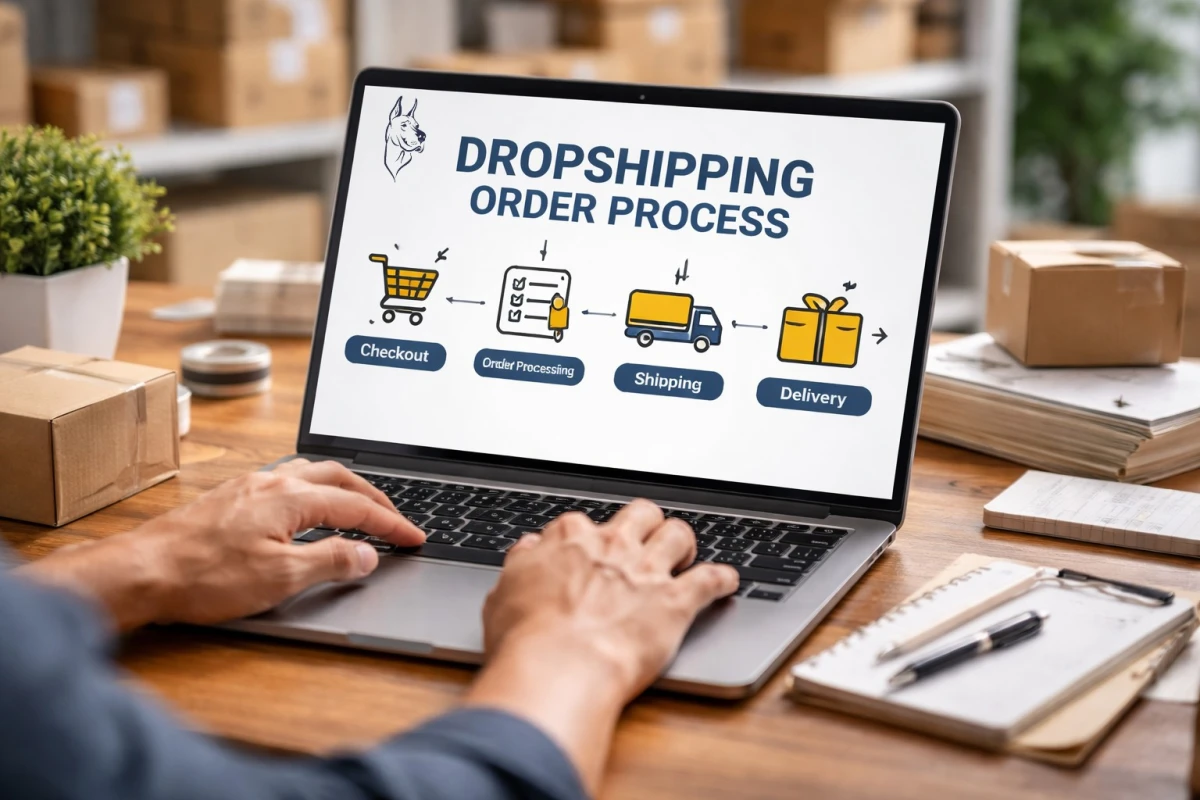
Behind every successful dropshipping sale is a multi-step fulfillment process involving checkout systems, payment verification, supplier communication, shipping logistics, tracking updates, and post-delivery support.
This guide complements broader explanations of dropshipping fundamentals, such as how dropshipping works, its benefits, and common myths, by focusing specifically on what happens after a customer places an order.
Understanding this order flow is essential for reducing refunds, avoiding chargebacks, and building a scalable dropshipping business.
If you’re new to ecommerce, start with our complete guide on how to start a dropshipping business, then come back here to understand what happens after the first sale.
🛒 Step 1 — Customer Checkout & Order Placement
The dropshipping process begins the same way as any ecommerce transaction: a customer places an order on your online store.
🔹 What happens at checkout:
✅ The customer selects a product and enters shipping details
✅ Payment is processed through your ecommerce platform
✅ The order is recorded inside your store’s order management system
✅ Inventory availability is checked (either live or cached)
At this stage, you collect the retail payment, not the supplier. The difference between your retail price and the supplier’s wholesale price is your gross margin.
⚠️ Where many retailers go wrong:
Selling products without accurate inventory or shipping data leads to cancellations, delays, and refund requests before fulfillment even begins.
🧾What Happens Behind the Scenes After Checkout (What Customers Never See)
From the customer’s perspective, checkout feels instant. Behind the scenes, however, a dropshipping order triggers a chain of validations and checks that determine whether fulfillment will succeed or fail.
Once payment is approved, the order enters a verification stage where product identifiers, shipping destinations, and inventory availability are confirmed. This step is critical because even small mismatches — such as outdated SKUs or incorrect shipping zones — can delay fulfillment or force cancellations. Reliable dropshipping systems validate these details automatically before an order ever reaches the supplier.
This behind-the-scenes layer is where experienced retailers differentiate themselves. Instead of reacting to fulfillment problems after the fact, they build workflows that prevent errors from occurring in the first place. Customers never see this infrastructure, but they feel the impact through faster shipping, fewer issues, and clearer communication.
🔄 Step 2 — Order Syncing & Automation Triggers
Once the order is placed, the next step is transferring that order to the supplier — either manually or automatically.
✅ Automated workflows include:
- Order details syncing to the supplier system
- Product SKU matching and validation
- Shipping method selection
- Address verification
- Fraud and payment confirmation
Automation dramatically reduces errors and fulfillment delays. Manual ordering, while possible, becomes risky as volume increases, especially for retailers who have not focused on setting up a scalable dropshipping operation.
💡 Key takeaway:
Automation doesn’t remove responsibility — it removes friction. Retailers are still accountable for what ships, when it ships, and how it arrives.
🏭 Step 3 — Supplier Receives & Confirms the Order
Once the supplier receives the order, they confirm:
✅ Product availability
✅ Shipping method and destination
✅ Processing timeline
✅ Compliance requirements (brand, marketplace, MAP)
At this point, inventory accuracy matters more than catalog size. Reliable suppliers prioritize consistency over volume.
Common supplier checkpoints:
- Address validation
- Product condition verification
- Packaging requirements
- Shipping label generation
This is where strong supplier vetting makes or breaks the experience.
📊Inventory Accuracy vs. Inventory Volume (Why Fewer Products Often Perform Better)
One of the most common misconceptions in dropshipping is that success comes from listing as many products as possible. In reality, inventory accuracy consistently outperforms inventory volume.
Large catalogs often hide unstable products — items that go out of stock, change specifications, or disappear without notice. When retailers build stores around these products, they inherit risk they can’t control — often tied to poor supplier reliability rather than marketing or demand.
Retailers who focus on fewer, more reliable products benefit from predictable fulfillment, cleaner automation, and lower support overhead. Inventory continuity allows retailers to scale marketing efforts with confidence instead of constantly chasing replacements. In dropshipping, stability compounds just as quickly as instability does.
📦 Step 4 — Picking, Packing & Fulfillment
After confirmation, the supplier prepares the order for shipment.
✅ Fulfillment includes:
- Picking the correct SKU
- Secure packaging
- Attaching shipping labels
- Including packing slips (branded or neutral)
Retailers may have options to:
- Use branded packing slips
- Remove supplier branding
- Customize return instructions
📌 Important note:
Even though the supplier ships the product, the retailer remains the customer-facing brand.
🚚 Step 5 — Shipping, Tracking & Carrier Handoff
Once shipped, the order is handed off to a carrier and tracking is generated.
Common carrier responsibilities:
- First-mile pickup
- In-transit updates
- Delivery confirmation
- Exception handling (delays, reroutes)
Tracking data is:
- Synced back to the retailer’s platform
- Shared with the end customer
- Used to manage support inquiries
For retailers selling primarily to U.S. customers, domestic fulfillment plays a critical role in meeting delivery expectations.
Delivery speed plays a major role in:
- Conversion rates
- Refund requests
- Chargeback risk
- Customer trust
📬 Step 6 — Customer Delivery & Post-Order Experience
Delivery is not the end of the order lifecycle — it’s the beginning of the customer’s experience with your brand.
After delivery, customers may:
- Track additional shipments
- Request returns or exchanges
- Leave reviews
- Contact support
Retailers must be prepared to:
- Handle delivery exceptions
- Communicate delays clearly
- Manage returns properly
- Maintain compliance with marketplace rules
Strong fulfillment reduces downstream support costs dramatically.
💳How Order Flow Impacts Chargebacks, Refunds, and Reviews
Dropshipping order flow doesn’t just affect logistics — it directly influences financial and reputational outcomes.
When fulfillment breaks down, the downstream effects are immediate. Delayed shipping leads to refund requests. Missing tracking increases disputes. Inconsistent delivery times drive negative reviews. Over time, these issues raise chargeback ratios and create friction with payment processors and marketplaces.
Retailers who understand the full order lifecycle design safeguards into their process. They align shipping expectations with reality, communicate proactively, and use tracking data to reduce uncertainty. This operational discipline doesn’t just protect margins — it protects the long-term viability of the business.
🤖Where Automation Fits Into the Dropshipping Workflow
Automation connects every step of the order lifecycle through dropshipping platforms that manage order syncing, inventory updates, tracking, and fulfillment visibility.
Automated systems can:
- Sync orders in real time
- Update stock levels
- Push tracking to stores
- Flag fulfillment errors
- Reduce manual intervention
However, automation only works when:
- Supplier data is accurate
- Shipping rules are enforced
- Platforms are properly integrated
⚠️ Automation does not fix poor suppliers — it amplifies them.
Retailers looking to go deeper on this topic can explore how automation enhances dropshipping efficiency, including order syncing, inventory updates, and tracking workflows.
🔁Why Dropshipping Order Flow Must Be Designed for Scale (Not Just Launch)
Many dropshipping stores function adequately at low volume but collapse under growth. The reason is simple: their order flow was never designed for scale.
Manual processes that work for a few orders per week become bottlenecks at higher volumes. Delayed supplier confirmations, spreadsheet-based workflows, and inconsistent shipping rules introduce friction that compounds as order count increases. Scaling exposes weaknesses that were always present — just hidden.
Designing order flow for scale means standardizing fulfillment rules, enforcing supplier accountability, and relying on automation that can handle volume without breaking. Retailers who invest in this early scale faster, with fewer disruptions, and with far less operational stress.
Retailers who treat fulfillment as a system—not a handoff—are better positioned to scale.
🚀 Ready to build a more reliable fulfillment process?
Learn how modern dropshipping platforms streamline orders from checkout to delivery.
🧩Platforms, Suppliers & Responsibility Boundaries
One of the biggest misunderstandings in dropshipping is who is responsible for what.
Responsibility breakdown:
✅ Retailer: customer experience, pricing, branding, compliance
✅ Supplier: fulfillment accuracy, packaging, shipping execution
✅ Platform: data syncing, automation, order visibility
Clear boundaries prevent finger-pointing and protect the retailer’s brand.
⚠️Common Dropshipping Fulfillment Mistakes to Avoid
❌ Selling without inventory verification
❌ Underestimating shipping expectations
❌ Using unreliable or unvetted suppliers
❌ Ignoring return workflows
❌ Treating fulfillment as “hands-off”
Dropshipping works best when retailers treat fulfillment as a core operation, not an afterthought.
This becomes even more critical when orders flow across multiple sales channels through marketplace integrations.
⚠️ Struggling with shipping delays or cancellations?
Discover why supplier reliability is the foundation of successful dropshipping fulfillment.
📈Why Understanding the Order Flow Improves Scaling
Retailers who understand the full order lifecycle can:
- Scale confidently
- Reduce refund rates
- Improve customer satisfaction
- Expand to new channels
- Protect margins
Scaling isn’t about adding more products — it’s about improving fulfillment reliability.
Dropshipping Is a Fulfillment Model, Not a Shortcut
Dropshipping doesn’t remove responsibility — it redistributes it. Retailers remain accountable for customer experience, delivery timelines, and post-order support, regardless of who ships the product. Understanding this distinction is essential for building trust and avoiding costly mistakes. The most successful dropshippers treat fulfillment as a core operation, not a background task.
🏁 Conclusion: Dropshipping Works Best When You Understand the Entire Flow
Dropshipping is not “set it and forget it.” It’s a fulfillment model that rewards retailers who understand the full order lifecycle — from checkout to delivery and beyond.
When retailers align platforms, suppliers, and automation correctly, dropshipping becomes scalable, predictable, and customer-friendly. When they don’t, small cracks turn into operational failures.
Understanding how dropshipping orders actually work is the foundation for building a sustainable ecommerce business.
🤖 Looking to scale without chaos?
See how proper order flow and automation reduce errors and support sustainable growth.
Related Articles
How to Start a Dropshipping Business
Dropshippers Explained: What Dropshippers Do, How They Make Money, and How to Succeed
How to Scale a Dropshipping Business Without Burning Out
Introducing TopDawg’s New Amazon Dropshipping App: Now Part of the Amazon Provider Network
Dropshipping Explained: How It Works, Benefits, and Common Myths
Shopify Dropshipping Success: How Automation & U.S. Suppliers Give You the Competitive Edge
Why TopDawg Ranks #1: What Makes It the Most Trusted U.S. Dropshipping Supplier
TopDawg Featured in Forbes: Why U.S.-Based Dropshipping Is the Future of eCommerce
How to Create a Professional Online Store for Dropshipping: A Step by Step Guide
AliExpress Dropshipping in Trouble? Why Retailers Are Moving to U.S. Suppliers in 2025
🖋️ About the Author
Darren DeFeo is the CEO of TopDawg, a U.S.-based dropshipping platform that helps thousands of retailers streamline eCommerce operations with verified American suppliers and automated fulfillment. With 20+ years in digital commerce and product innovation, Darren focuses on building sustainable growth systems that help entrepreneurs scale with confidence.
When he’s not leading TopDawg, Darren is cultivating partnerships that keep retailers ahead of market shifts — especially in logistics, automation, and the evolving U.S. trade landscape.
Frequently Asked Questions
Additional Resources





Create a Free Account to Get Started
Creating a free account only requires a valid email address, with no credit card needed.