BLOG
How to Scale a Dropshipping Business in 2026 Without Burning Out
By Darren DeFeo | Updated on January 9, 2026
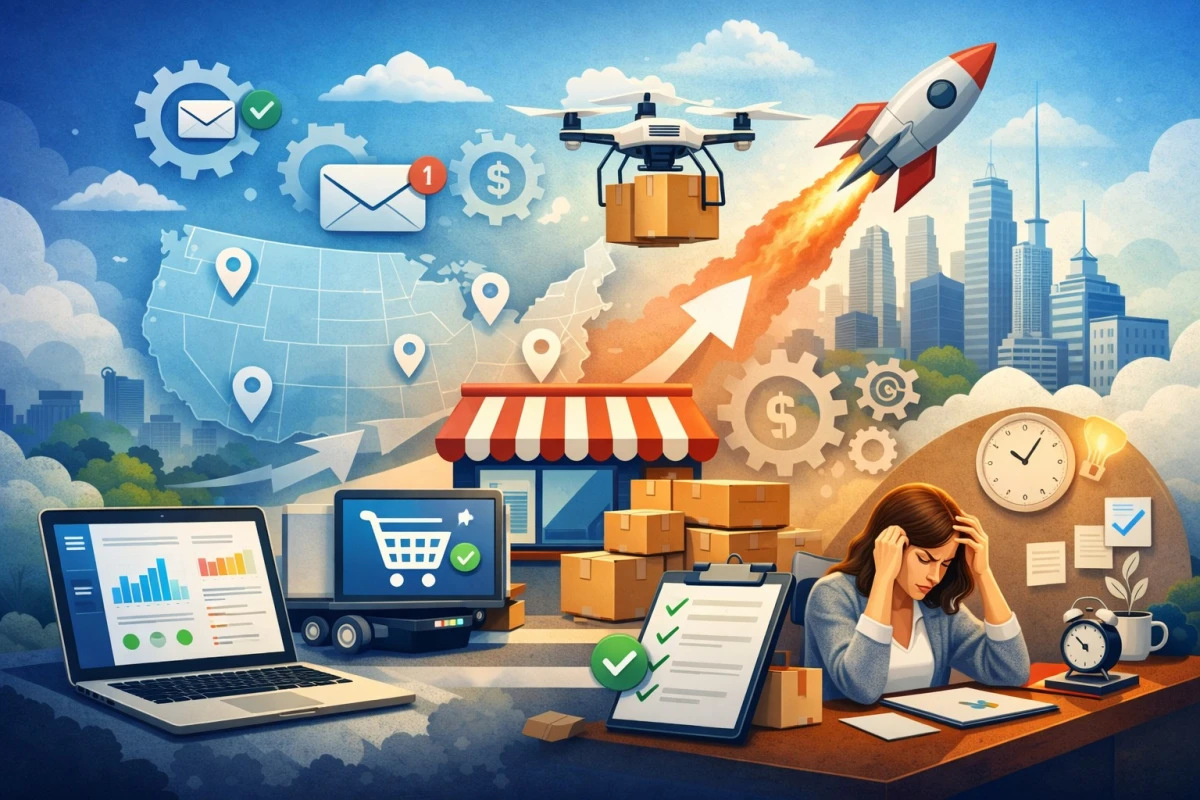
Why Scaling a Dropshipping Business in 2026 Leads to Burnout... and How to Avoid It
Ready to scale your dropshipping business without losing your sanity? You’re not alone. More than 85% of dropshippers who attempt rapid scaling experience burnout before they ever reach meaningful, sustainable growth.
The reason isn’t a lack of effort, ambition, or intelligence. Most burnout happens because growth outpaces infrastructure.
Scaling successfully starts with understanding how the dropshipping model actually works. Retailers who misinterpret the role of the dropshipper often scale prematurely and create operational strain. Before focusing on growth, it’s important to understand what dropshippers actually do and how professional operations are structured.
In 2026, scaling a dropshipping business successfully requires more than finding winning products or increasing ad spend. It requires systems, automation, and reliable supplier partnerships that allow your business to grow without demanding more of your time, energy, and mental bandwidth.
With the right approach—and dependable U.S.-based suppliers supporting your operation—you can build a business that scales steadily, profitably, and predictably. Let’s walk through how to do it the smart way.
Why Most Dropshippers Burn Out During Scaling
Why do so many promising dropshipping businesses collapse under their own success?
Because they try to scale everything at once—without first stabilizing what already exists.
Many entrepreneurs increase advertising budgets, add dozens of new products, expand to multiple platforms, and attempt to grow their team while still handling orders, customer service, and inventory manually. At low volume, this may be manageable. At scale, it becomes overwhelming.
⚠️ What Burnout Looks Like in Practice
When systems lag behind growth, common problems appear quickly:
- ❌ Order volume increases 300%, but fulfillment remains manual
- ❌ Customer complaints surge due to shipping delays or inventory issues
- ❌ Profit margins shrink from rushed decisions and supplier mistakes
- ❌ Work-life balance disappears as founders respond to constant issues
- ❌ Brand reputation suffers from inconsistent customer experience
Scaling doesn’t create problems—it amplifies existing ones. If your operation is fragile, growth exposes it fast.
The solution isn’t to grow slower.
The solution is to build before you scale.
💡 Burnout usually isn’t a motivation problem — it’s a systems problem. Retailers who scale with reliable U.S.-based suppliers and automation avoid many of the issues that derail growth early.
The Smart Way to Scale in 2026: Systems First, Growth Second
Successful scaling in 2026 isn’t about speed. It’s about readiness.
The most successful dropshippers follow a simple principle: infrastructure before expansion. That means building systems, processes, and partnerships capable of handling ten times your current volume before you actually reach it.
This approach turns scaling from a stressful guessing game into a predictable, manageable process.
🧩 The 4 Pillars of Sustainable Scaling
Automation Infrastructure
Every repetitive task should run without your direct involvement. At scale, even small manual tasks become time-consuming bottlenecks.
Key automation areas include:
- ✅ Order processing and fulfillment
- ✅ Inventory updates and alerts
- ✅ Customer notifications and tracking emails
- ✅ Basic customer service responses
Automation ensures that increased revenue doesn’t require increased labor.
Reliable Supplier Partnerships
As your order volume grows, suppliers become one of the most critical factors in your success—or failure.
U.S.-based dropshipping suppliers offer:
- Faster and more predictable shipping
- More consistent inventory availability
- Clearer communication during high-volume periods
- Better quality control
These advantages become exponentially more important as your business scales.
Data-Driven Decision Making
Scaling should never be based on gut instinct alone.
Successful dropshippers rely on performance data to decide:
- Which products to scale
- Which marketing channels to expand
- Which suppliers to prioritize
- Which initiatives to cut
Data-driven decisions reduce risk and prevent wasted effort.
Financial Systems
Financial chaos is one of the fastest ways to derail a growing business.
Proper bookkeeping, cash-flow management, and tax planning ensure:
- You understand true profitability
- You reinvest wisely
- You avoid unpleasant surprises during growth
Scaling without financial visibility is like driving blindfolded.
🔧 Scaling becomes dramatically easier when order processing, inventory syncing, and supplier communication are automated through a single platform. Retailers who invest early in streamlined dropshipping operations are far less likely to experience burnout as order volume increases.
Step-by-Step Scaling Strategy That Prevents Burnout
Phase 1: Stabilize Your Foundation (Weeks 1–4)
Before increasing ad spend or adding products, your existing operation must run smoothly.
Weeks 1–2: Audit Your Systems
Take an honest look at how your business currently operates:
- ✅ Track how much time you spend on manual tasks
- ✅ Identify every process that requires your direct involvement
- ✅ Document profit margins by product
- ✅ Review customer complaints and satisfaction trends
This audit highlights where automation and process improvements are needed most.
Weeks 3–4: Implement Core Automation
Once bottlenecks are identified, focus on automation:
- ✅ Automatic order processing
- ✅ Inventory alerts and restock notifications
- ✅ Email flows for order confirmations and shipping updates
- ✅ Automated responses for common customer questions
Critical success benchmark:
You should be able to step away from your business for 48 hours without issues. If orders stop processing or customer inquiries pile up, you’re not ready to scale.
Phase 2: Optimize Your Best Performers (Weeks 5–8)
Instead of adding new products, focus on improving what already works.
Most dropshipping businesses generate the majority of their profits from a small percentage of products. Identifying and optimizing these “winners” creates a strong foundation for scaling.
Product Performance Analysis
Track:
- ✅ Revenue per product (last 90 days)
- ✅ Profit margins
- ✅ Return and complaint rates
- ✅ Supplier reliability
- ✅ Marketing cost per sale
Focus on the top 20% of products producing 80% of profits.
Optimization Strategies
- ✅ Improve product images and descriptions
- ✅ Test pricing strategies to maximize margin
- ✅ Expand keyword targeting for proven sellers
- ✅ Strengthen relationships with reliable suppliers
Optimizing winners often produces faster growth with far less risk than chasing new opportunities.
Phase 3: Smart Expansion (Weeks 9–16)
Once your foundation is stable and top products are optimized, growth becomes far more manageable.
Expansion Priority Order
- ✅ Increase ad spend on proven products
- ✅ Add complementary items
- ✅ Expand to new audiences
- ✅ Add new platforms
- ✅ Explore new niches
Rule: Master one level before moving on. Controlled expansion prevents chaos.
Essential Automation Tools for Scaling Without Stress
🔄 Order Management Automation
Key automations include:
- ✅ Automatic order routing
- ✅ Real-time inventory updates
- ✅ Tracking notifications
- ✅ Profit tracking by product line
📣 Marketing Automation Systems
Marketing automation allows growth without constant manual effort:
- ✅ Abandoned cart recovery
- ✅ Post-purchase upsells
- ✅ Retention and win-back campaigns
- ✅ Automated ad optimization
💬 Customer Service Automation
Customer service often becomes a bottleneck during scaling.
Automation helps by:
- ✅ Handling order status inquiries
- ✅ Routing tickets by priority
- ✅ Providing response templates
- ✅ Escalating complex issues only when needed
Automation ensures growth doesn’t overwhelm your support resources.
Financial Management for Sustainable Growth
💵 Cash Flow Management (25-30-45 Rule)
A simple guideline many successful dropshippers follow:
- ✅ 25% set aside for taxes
- ✅ 30% reinvested in growth
- ✅ 45% allocated to income and reserves
📊 Smart Reinvestment Areas
High-impact reinvestments include:
- ✅ Product photography and video
- ✅ Website optimization
- ✅ Premium supplier partnerships
- ✅ Advanced analytics tools
- ✅ Customer service improvements
Avoid common traps such as hiring too early or investing in tools you don’t yet need.
Platform-Specific Scaling Strategies
🛒 Shopify Scaling Strategy
Shopify excels at automation and customization:
- ✅ App-based workflow automation
- ✅ SEO-driven organic growth
- ✅ Email marketing for retention
- ✅ Advanced analytics
📦 Marketplace Scaling (Amazon, Walmart, eBay)
Marketplace scaling focuses on:
- ✅ Listing optimization
- ✅ Platform-native advertising
- ✅ Review and performance management
🔁 Multi-Platform Management
Once systems are established:
- ✅ Centralize inventory management
- ✅ Use unified customer service tools
- ✅ Maintain consistent branding
Why U.S. Suppliers Are Essential for Scaling in 2026
🚚 Speed Advantages
- ✅ 2–5 day delivery times
- ✅ Higher customer satisfaction
- ✅ Faster testing and iteration
🧱 Reliability Under Pressure
- ✅ Stable inventory levels
- ✅ Same-timezone communication
- ✅ Scalable fulfillment capacity
📉 Cost-Effectiveness at Scale
- ✅ Fewer returns
- ✅ Fewer support issues
- ✅ Better margins over time
- ✅ Reduced tariff exposure
👉 Explore how U.S.-based supplier platforms support sustainable dropshipping growth.
Common Scaling Mistakes That Cause Burnout
- ❌ Scaling before stabilizing
- ❌ Chasing every opportunity
- ❌ Ignoring customer experience
- ❌ Choosing suppliers on price alone
- ❌ Refusing to automate
Your 90-Day Scaling Action Plan
✅ Days 1–30: Foundation
- Automate core operations
- Secure reliable U.S. suppliers
- Establish financial tracking
✅ Days 31–60: Optimization
- Improve best sellers
- Strengthen marketing funnels
- Build retention systems
✅ Days 61–90: Expansion
- Increase spend on proven products
- Add complementary items
- Expand strategically
🚀 Retailers who scale successfully in 2026 focus less on shortcuts and more on building repeatable systems that grow with them.
Final Thoughts: Scale Smart, Scale Sustainable
Scaling a dropshipping business in 2026 doesn’t require sacrificing your health, relationships, or sanity. It requires systems, automation, reliable suppliers, and financial clarity.
Build once. Scale calmly. Grow with intention. 🚀
Related Articles
Dropshippers Explained: What Dropshippers Do, How They Make Money, and How to Succeed
Introducing TopDawg’s New Amazon Dropshipping App: Now Part of the Amazon Provider Network
Dropshipping Explained: How It Works, Benefits, and Common Myths in 2026
Shopify Dropshipping Success: How Automation & U.S. Suppliers Give You the Competitive Edge
How to Start a Dropshipping Business
Why TopDawg Ranks #1: What Makes It the Most Trusted U.S. Dropshipping Supplier
TopDawg Featured in Forbes: Why U.S.-Based Dropshipping Is the Future of eCommerce
How to Create a Professional Online Store for Dropshipping: A Step by Step Guide
AliExpress Dropshipping in Trouble? Why Retailers Are Moving to U.S. Suppliers in 2025
How to Start Dropshipping on the Walmart Marketplace with TopDawg
Top 10 USA-Based Dropshipping Suppliers (Why TopDawg Leads the Pack)
🖋️ About the Author
Darren DeFeo is the CEO of TopDawg, a U.S.-based dropshipping platform that helps thousands of retailers streamline eCommerce operations with verified American suppliers and automated fulfillment. With 20+ years in digital commerce and product innovation, Darren focuses on building sustainable growth systems that help entrepreneurs scale with confidence.
When he’s not leading TopDawg, Darren is cultivating partnerships that keep retailers ahead of market shifts — especially in logistics, automation, and the evolving U.S. trade landscape.
🔗 Connect with Darren on LinkedIn
Frequently Asked Questions
Additional Resources






Create a Free Account to Get Started
Creating a free account only requires a valid email address, with no credit card needed.